


Why CarMax’s Online Reputation Potholes are Slowing its Recovery
Apr 22, 2026|Read time: 5 min.
Key Points
-
CarMax’s reputation is unfolding on the first page of Google and in AI-generated results, where trust is formed and purchase decisions begin.
-
Negative search visibility can have far-reaching impacts, like on the customer mix, suppressing conversions, increasing and potentially raising long-term credit risk.
-
Without actively reshaping its search presence, CarMax risks undermining its own recovery before customers ever engage.
The most important showroom in the auto industry is the first page of Google. That’s especially true for a brand like CarMax, the largest used vehicle retailer in the United States, which is trying to execute a turnaround strategy in full public view.
CarMax is entering a pivotal phase, with a new CEO, new board influence tied to activist investor pressure, and renewed urgency around profitability. Today’s earnings beat gives CarMax a credible business narrative to build on.
But for brand and marketing leaders, the more consequential question is whether the company can rebuild trust where modern customers actually form it: in search.
Because a successful turnaround is just as much about brand reputation as it is about balance sheets.
CarMax faces reputational headwinds
CarMax differentiated itself by reducing friction in one of retail’s least trusted categories. Its transparent pricing model, national distribution, and 10-day money back guarantee helped it become a leader in the used auto marketplace with $26 billion in annual revenue.
But the automotive giant has struggled in recent years, at least in part due to a series of reputational headwinds wearing down brand trust.
Branded search results highlight criticism tied to lawsuits, employee dissatisfaction, pricing complaints, financial pressure, and activist intervention. Negative content has appeared prominently in organic results, alongside unfavorable “People Also Ask” questions, critical video results, and user commentary that reinforces skepticism for in-market consumers.
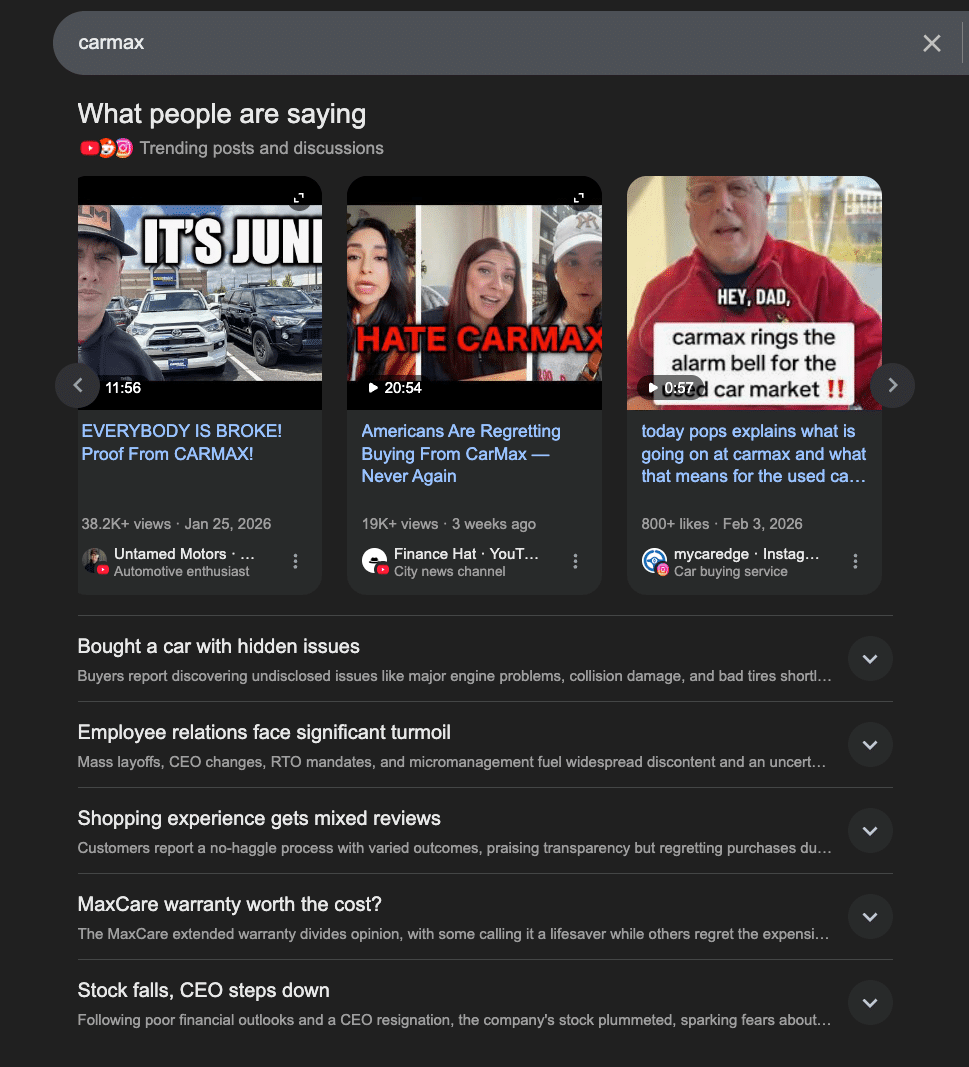
Source: Google, April 14, 2026
Unfavorable content persists throughout the funnel, including for crucial decision-stage queries like “How are CarMax prices?” or “Are CarMax cars reliable?”.
When a narrative becomes consistent and prominent, Google, ChatGPT and other generative AI platforms may begin to synthesize topics into their responses.
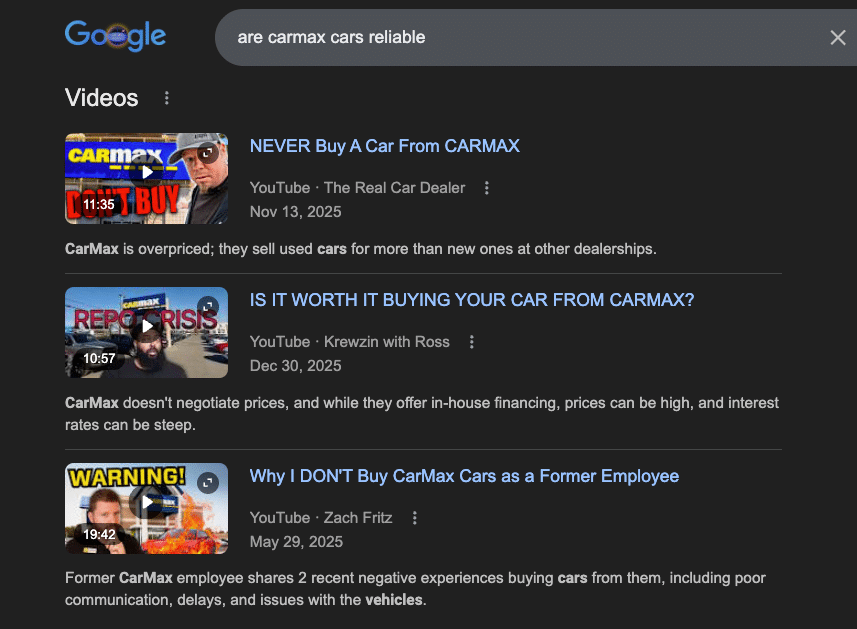
Source: Google, April 14, 2026
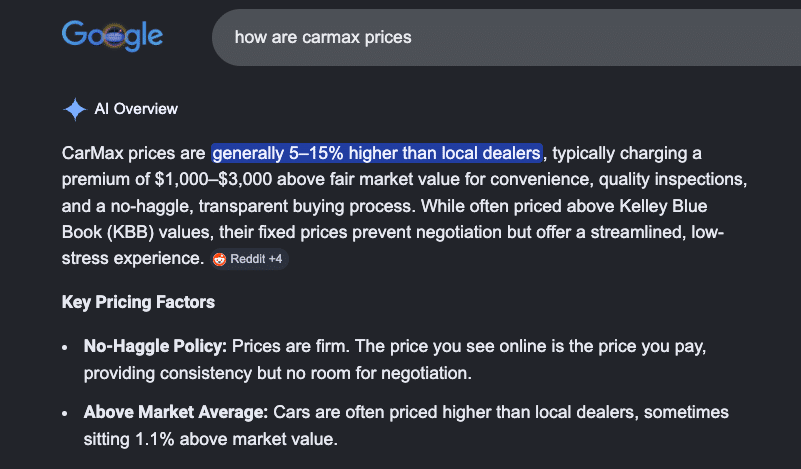
Source: Google, April 14, 2026
When page one is filled with critical commentary, legal headlines, or videos warning customers to stay away, the brand is forced to absorb friction at the most commercially sensitive point in the journey.
The business impact of brand reputation
CarMax’s unfavorable brand reputation on the front page of Google — its digital showroom — has downstream implications for customer quality, pricing power, and long-term profitability.
Depressed retail sales as consumers select competitors
A negative search environment can push qualified consumers toward competitors. Buyers with stronger credit, more flexibility, and more time to shop around are often the quickest to walk away when trust erodes. This can have an immediate impact on sales.
A negative brand reputation has been shown to suppress dealership sales by diverting high-intent buyers before they ever visit a location. In a category where shoppers compare multiple dealers and marketplaces, page one can become a silent but powerful source of lost consideration.
Higher-risk portfolio mix as top-tier buyers opt out
When a brand develops an unfavorable search environment around trust, pricing, or reliability, it may become relatively less attractive to lower-risk consumers and more tolerable to buyers with fewer options. That does not mean the business suddenly serves only high-risk customers. However, reputation weakness may shift the customer mix towards subprime borrowers.
This risk might not be immediately visible because sales may remain steady. But over time, CarMax could see gradually rising delinquency rates due to a greater percentage of distressed borrowers.
Decreased trust leads to pricing pressure
When buyers encounter skepticism on Google’s page one or in AI summaries, the perceived value of the brand weakens. That can make pricing feel less defensible, especially in a category where consumers are already highly sensitive to fairness and transparency. If trust barriers rise, inventory may need to be priced more aggressively to convert shoppers who otherwise would have paid a premium for convenience, selection, or perceived safety.
In that sense, a negative search landscape can create indirect pricing pressure. The company may need stronger offers, deeper discounts, or more promotional support to compensate for a trust deficit that appears before the customer ever engages with the brand directly.
This can squeeze margins as CarMax must still acquire inventory at the same market rates as competitors while reducing prices and maintaining its competitive advantages of a 10-day money back guarantee and multi-point inspections.
Employee sentiment can become an operating cost
Brand reputation shapes how current and prospective employees view the company.
When unfavorable search narratives consistently surface stories about dissatisfaction, instability, or increased workload, they can weaken employee confidence in the brand and leadership. That may show up in higher turnover, more difficulty attracting strong candidates, and greater recruiting costs as the company has to work harder to overcome skepticism in the talent market.
There can also be a quieter internal cost. Employees who feel less pride in where they work may become less engaged, less loyal, and less productive over time. They may dread going to work, take more time off, or quietly begin searching for new jobs.
In a turnaround, employee sentiment matters. Frontline experience, operational consistency, and customer trust are all heavily influenced by employee motivation. If the search landscape reinforces doubt externally, it can validate and amplify disengagement internally.
Why earnings momentum alone won’t fix the problem
CarMax’s earnings beat gives leadership a timely proof point that operational improvements are moving the needle in the right direction.
But short-term financial news doesn’t change what customers see when they search the brand. Entrenched criticism, skeptical video content and synthesized AI summaries about the buying experience and product quality continue to erode trust throughout the buying journey.
For turnaround brands, reputation recovery has to be managed decisively.
Leadership teams should be watching tracking the search landscape with the same seriousness they bring to revenue trends and margin performance. They should understand which third-party narratives dominate page one, which trust questions show up most often, and where content gaps leave customers to be educated by critics instead of the brand.
Most importantly, they should recognize that in today’s market, third-party search results are more than reflections of reputation. They are active participants in shaping it.
The takeaway for brand leaders
CarMax may improve operations from the inside. But recovery will still be judged from the outside in.
That is the broader lesson for brand and marketing leaders. In a turnaround, search visibility can influence who converts, who defects, what it costs to acquire customers, and how investors, employees, and consumers interpret the brand’s trajectory. When page one reinforces instability, poor value, or questionable reliability, the damage shows up in earnings reports.
The balance sheet may signal that a recovery has begun. But the front page of Google will influence whether the market believes it.


Learn how consumer insights can drive consumer connection
What We DoUnlock instant access to 25+ digital marketing resources and the OAO 101 introductory email course to kick start your strategy.