

Fixing Navient’s $854 Million Reputation Problem
Mar 31, 2026|Read time: 7 min.
Key Points
- Naviant’s stock has fallen 53% since the Federal loan ban was announced in 2024, erasing $854M in market capitalization.
- Navient’s unfavorable branded search environment could be impacting customer acquisition, operating margins, and credit risk.
- Navient could be losing as much as $225M in annual loan originations due to its online search reputation.
Navient, once a billion-dollar juggernaut in the student loan space, is now plagued by high expenses, declining revenue, and multiple consecutive earnings report misses. Since the Federal loan ban was announced in September 2024, the stock has fallen 53%, erasing $854M in market capitalization.
Analysts attribute the company’s headwinds to rising delinquencies, write-downs, and higher borrowing costs as the company transitions from federal loan servicing to private lending and refinancing.
However, those challenges could be exacerbated by another problem: Navient’s deteriorating brand reputation.
Navient’s brand reputation is under siege
When potential borrowers search for information about Navient student loans, the front page of Google highlights damaging content about regulatory actions, settlements, and federal loan bans.
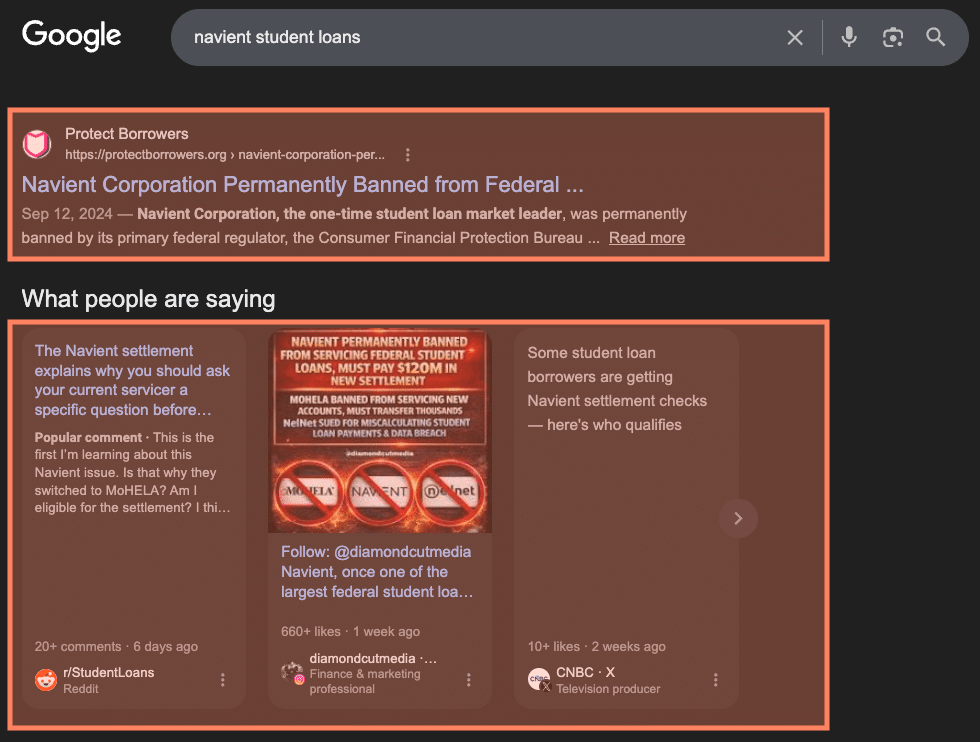
Source: Google, 3/12/26
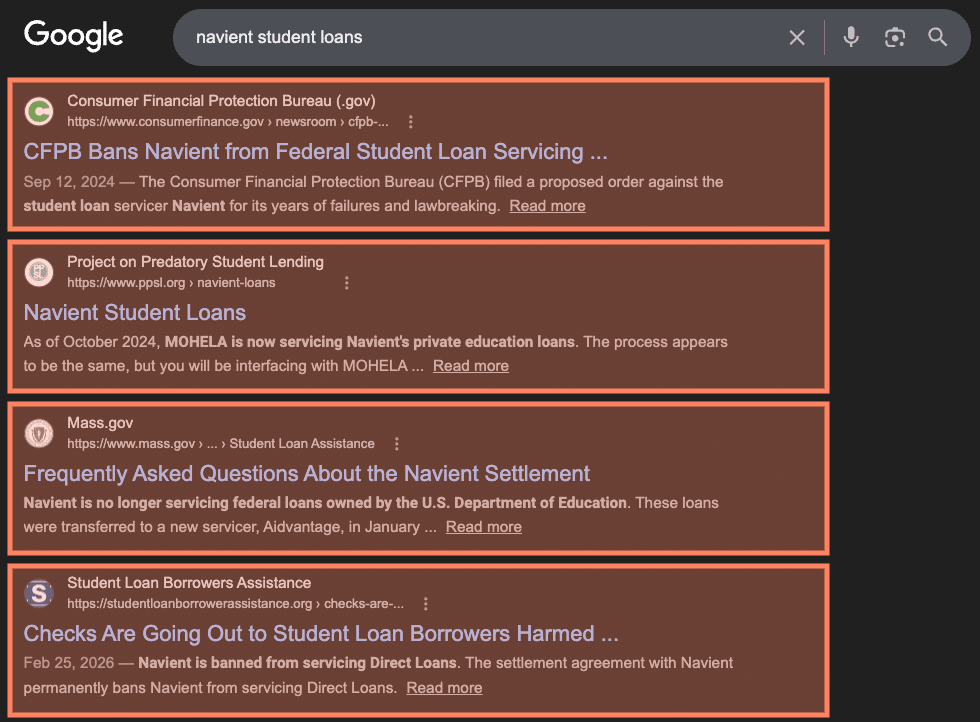
Source: Google, 3/12/26
The problem isn’t tethered to a single bad article or even a short-term news cycle.
According to Terakeet’s proprietary data, more than 70% of Google’s indexed content about Navient contains information about the federal loan ban and settlement. The topic has become so integrated with the brand’s knowledge graph that negativity no longer vanishes when viral news cycles end. It’s a constant, unmitigated crisis.
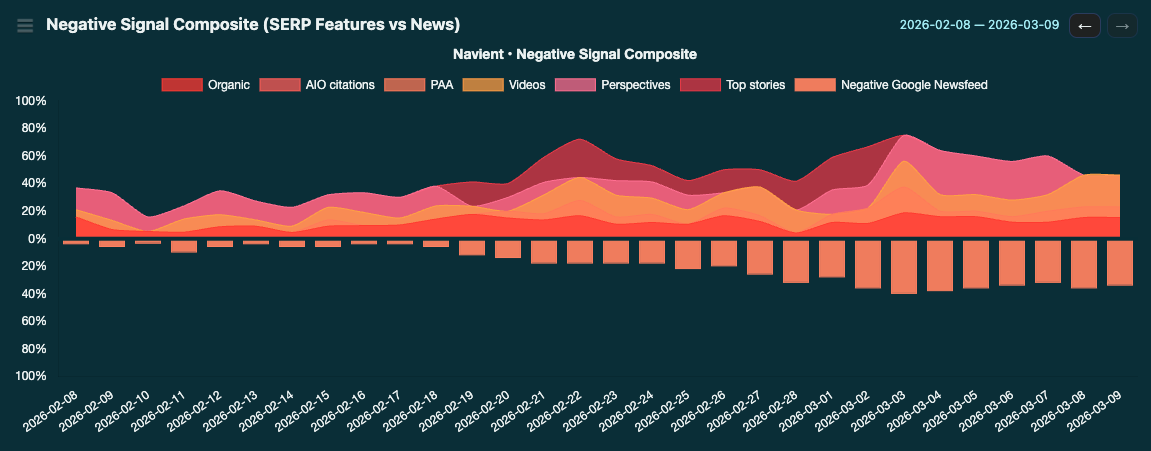
Source: Terakeet
Generative AI misrepresents Navient’s policies
In addition to highlighting negative content, Google’s AI summaries also misrepresent Navient’s current lending offerings. This could confuse borrowers near the point of purchase.
For example, when asked if Navient offers student loans, Google’s AI Overview states that the company no longer issues private student loans and describes the company as a marketplace to compare loans.
A more accurate and favorable description would explain that Navient now offers student loans and refinancing through its subsidiary brand Earnest.
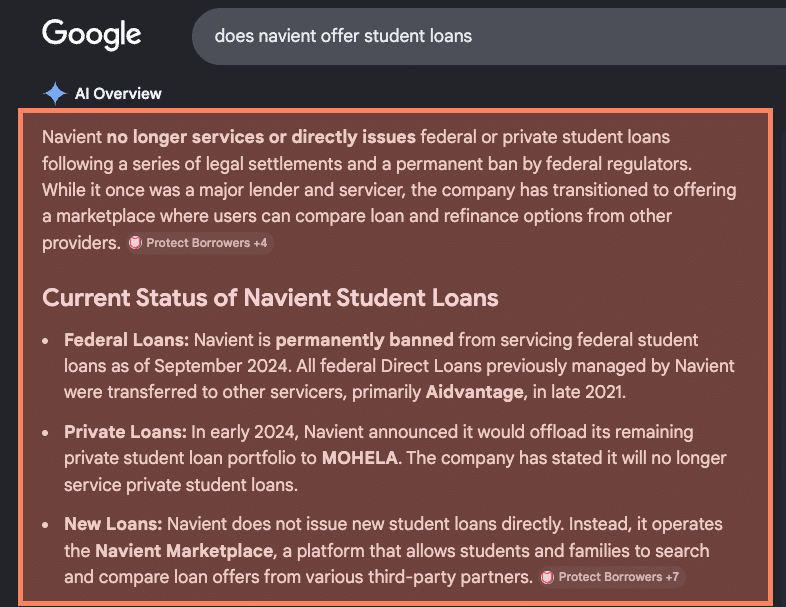
Source: Google, 3/12/26
Generative AI responses also frequently state that NaviRefi is invitation-only or exclusively available to existing customers. This confusion could drive away borrowers who were ready to apply for financing with Navient.
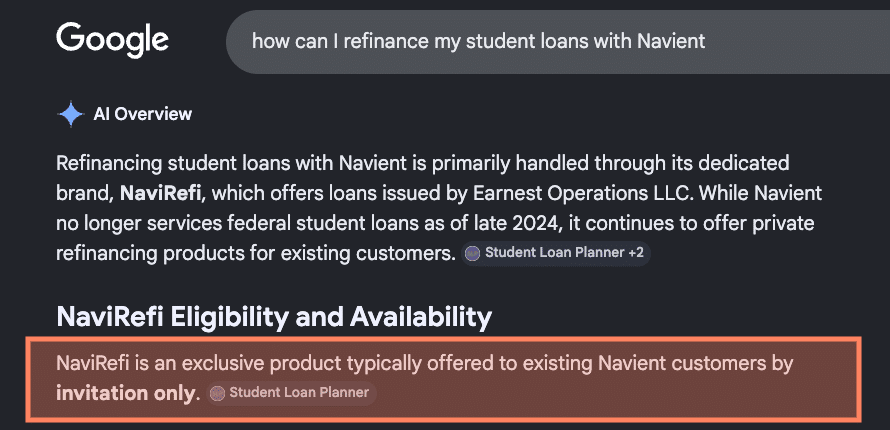
Source: Google, 3/12/26
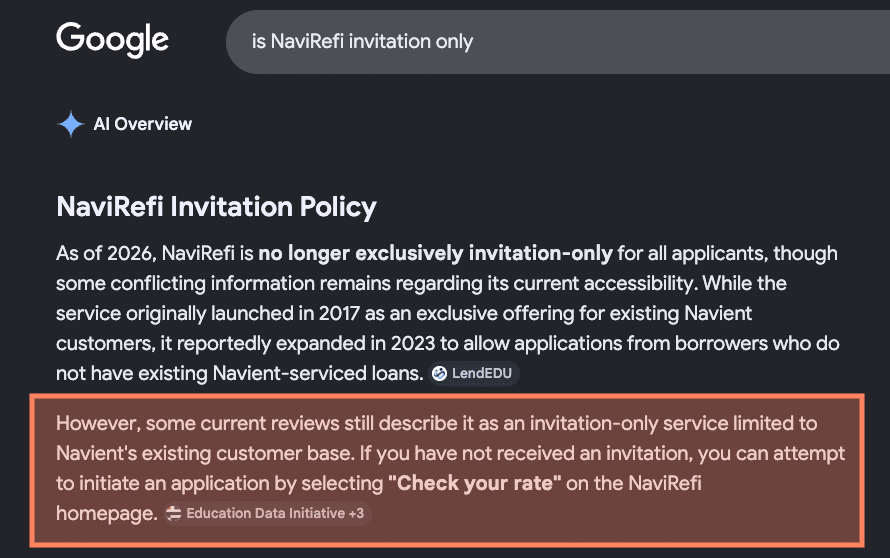
Source: Google, 3/12/26
Traditional PR and SEO are insufficient to correct hallucinated or outdated AI information in generative search. Brand leaders need a new, hybrid approach that understands how generative AI narratives are formed and influenced.
Why Navient’s brand reputation still matters
Navient spent more than a decade building brand equity with borrowers, and that legacy recognition is still visible in search data today. Despite the company’s recent controversies, Google Trends shows that 26% more potential borrowers search for “Navient student loans” than “Earnest student loans.”
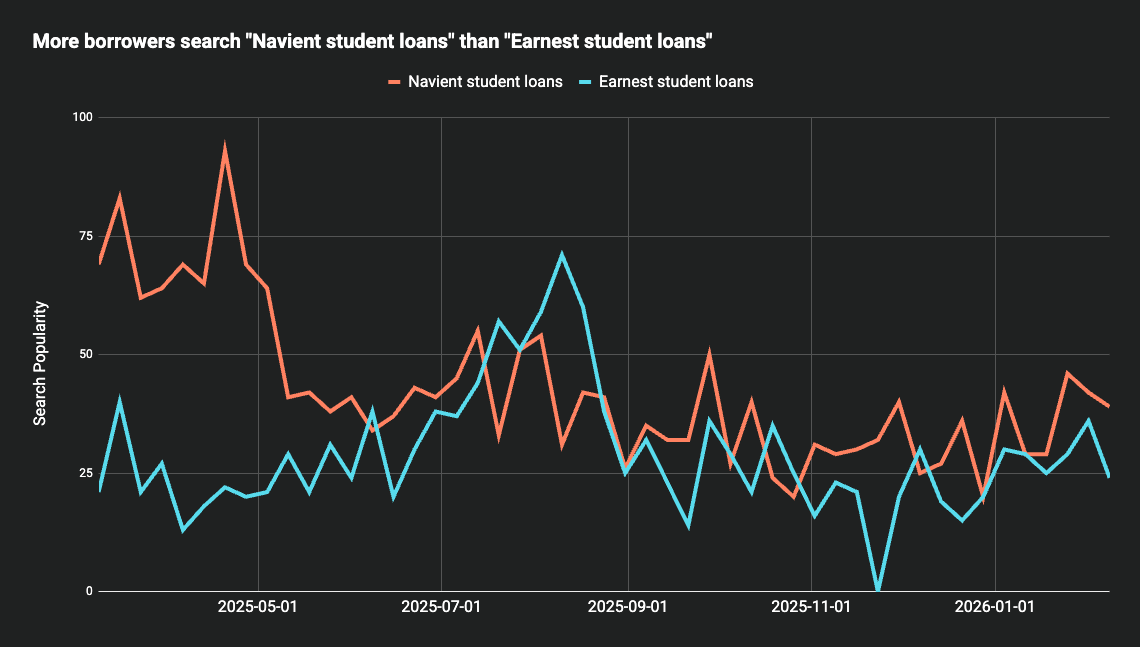
Source: Google Trends
This disparity highlights an important dynamic: while Navient has shifted its lending strategy toward the Earnest platform, many borrowers still associate the Navient brand with student lending.
In theory, that demand could be redirected into revenue. Borrowers searching for Navient-related terms represent a pool of high-intent prospects that could easily be funneled into Earnest’s loan and refinancing products.
However, when borrowers search Navient-related queries, the first page of Google frequently surfaces regulatory actions, settlement coverage, or inaccurate information about its products. As a result, borrowers who originally searched for Navient may abandon the brand and choose a competing lender.
Earnest isn’t immune to these reputational challenges, either. When borrowers search for “Earnest student loans,” Google reveals its relationship with Navient, effectively reintroducing the same reputational narrative into the Earnest discovery process.
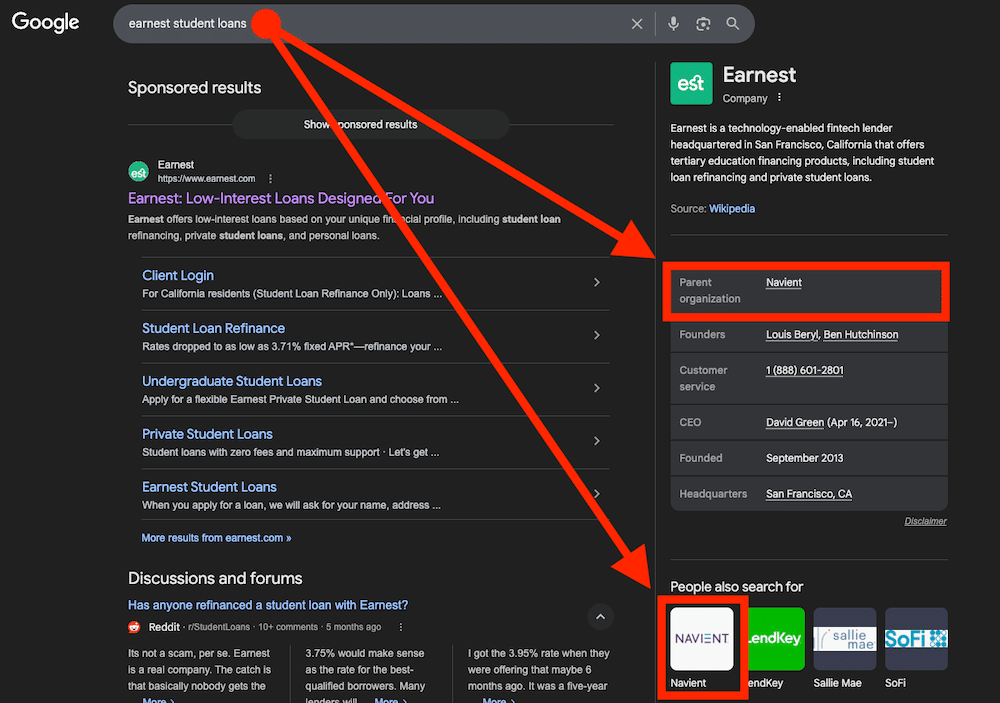
Source: Google, 3/12/26
In other words, Navient cannot simply distance itself from its legacy brand reputation. The association is embedded in the search ecosystem, and it increasingly spills over into the Earnest search landscape as well.
The business impact of Navient’s reputational damage
This unfavorable search environment introduces several potential risks for Navient: fewer customers, increased acquisition costs, and elevated borrower risk.
To illustrate the potential impact on loan originations, consider a simplified scenario analysis using the following assumptions:
- approximately 150,000 annual branded searches related to Navient student loans
- a typical student loan value of $20,000
- a baseline conversion rate of 10% on website visits from branded searches
Without unfavorable page-one content deterring borrowers, Navient might sign $300 million in annual student loans through those branded searches. However, if negative search narratives reduce conversion rates, the revenue impact can be significant.
| Scenario | Conversion Loss | Estimated Revenue Loss |
| Conservative | 25% | $75M |
| Moderate | 50% | $150M |
| Severe | 75% | $225M |
These figures are not precise forecasts, but they illustrate how search reputation can translate into financial loss by deterring high-intent borrowers.
In addition to lost revenue, Navient’s unfavorable search results might filter out highly qualified borrowers. This could skew the applicant pool toward higher-risk borrowers with fewer options who are more likely to default on loans in the future.
These challenges are like a perfect storm that weakens operating margins and affects the company’s long-term credit risk and loan loss provisions.
This creates a negative feedback loop within the search ecosystem: disappointing quarterly reports generate more unfavorable press which attracts activist investor attention, which creates more bad press.
Critical next steps for Navient
Navient’s reputational downturn won’t resolve itself. Without intervention, growth may lag, and margins might contract, prompting investors to push for leadership change.
Although it will take time and resources, Navient can take concrete steps to restore its brand reputation.
- Audit the digital landscape: Inventory brand mentions across Google’s search index and organize content around controlability, sentiment, and topical themes.
- Determine vulnerabilities: Uncover and mitigate the sources driving unfavorable brand narratives in traditional and generative search.
- Build a moat: Activate controlled and managed digital assets to establish a more resilient search barrier against negative press.
- Initiate early threat detection: Monitor branded search results with an always-on crisis alert system to stay ahead of threats.
When search becomes reputation infrastructure
The broader lesson extends beyond Navient.
News cycles, regulatory actions, and AI-generated summaries can quickly transform the information environment surrounding a brand and its products. Once embedded in search features, those signals can persist long after the original headlines fade.
Even when there’s nothing negative in a brand’s search results, generative AI can misrepresent its products and policies, injecting confusion into the buying journey. For companies operating in regulated financial markets, that dynamic can influence trust and confidence at the moment decisions are being made.
In Navient’s case, it’s still possible to transform its reputation from a liability into an asset. The challenge will be overcoming past narratives to recapture existing demand and restore trust with its consumer base.

The Brand Intelligence Report
Exclusive AI insights, search trends, and brand strategies, delivered to your inbox.